A drive that disconnects on its own, or that accepts a format which never sticks, has a hardware fault in its controller. Recovery software reads sectors through that controller, so if the controller is gone, so is the software route. Chip-level work in a lab is the only remaining option, and it costs more than the drive.
The tells for a hardware fault are consistent, and you can check them in an afternoon. The drive shows up for a few seconds, then drops off by itself. The same error follows it to every PC you try, not just yours. "F:\ The directory name is invalid" keeps coming back after every fix. Data recovery professionals answering these threads say the same thing: the controller is failing, there is no DIY fix, take it to a specialist. The threads behind that verdict are linked in the pitfalls below.
The reason is mechanical. Every program that reads a USB stick, ours included, talks to the flash chips through the drive's controller. There is no way around it, because the controller is what turns "read this file" into the raw commands that the NAND chips actually understand, and when it stops answering, a recovery scanner is left holding a cable to a device that will not speak to it. Only a lab that can lift the chips out and read them directly has a route in. That service costs far more than the drive did.
None of this is sales-friendly on a page that also sells recovery software. We say it anyway, because the alternative is you spending an evening on driver reinstalls for a stick that died last week. Our scanner cannot read a dead controller. Neither can anyone else's, whatever the download page promises you.
Which ADATA recovery tool should you pick?
For files, pick a read-only scanner that never writes to the source drive; the free tiers of most tools let you confirm your data is findable before you pay anything. For the drive itself, ADATA's own utility is the correct first stop, since it is free and made for your hardware. Do not expect one product to do both jobs.
The table below sorts the common names by what they actually do. Free caps are taken from the pages linked on this page, quoted so you can test before paying, not as a ranking.
| ADATA flash drive repair tool | What it does | Free tier (as published) | Erases the drive? |
|---|---|---|---|
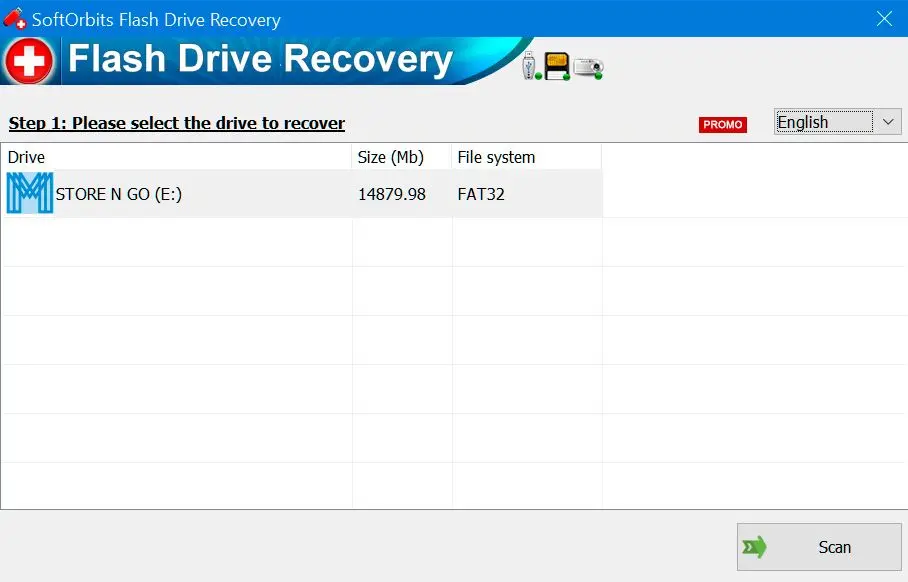
| SoftOrbits Flash Drive Recovery | Recovery - reads USB sticks, cards and camera media (FAT32, NTFS) | Preview before purchase | No, reads the drive |
| ADATA Online Recovery Tool | Repair - validates the model, rebuilds firmware, formats the drive | Free | Yes, by design |
| MiniTool Power Data Recovery | Recovery - read-only scan | 1 GB | No |
| Disk Drill | Recovery - scan and preview | 500 MB | No |
| Aidfile Recovery | Recovery - undelete, unformat and full scan | 1 GB | No |
| Windows format / chkdsk | Repair - rebuilds the file system | Built in | Yes, or worse |
So, two rules. A recovery tool must never write to the drive it is reading. A repair tool should come from the manufacturer or from Windows, because unsigned chip-level flashers off download portals are how a recoverable drive becomes a paperweight. The same split applies across brands, which is why our comparison of USB flash drive repair tools lists what each one writes to your media.
Why SoftOrbits Flash Drive Recovery fits an ADATA stick
Flash Drive Recovery is a desktop scanner built for removable media, and you save what it finds to a different disk, so nothing goes back onto the ADATA stick. That covers the two states most ADATA owners arrive in. Files deleted off the stick, and a stick that went RAW or got quick-formatted with the files still on it.
Pros:
Scans the ADATA drive and saves the results to another disk, so the stick is not overwritten while you work
Handles deleted and damaged files, including after a quick format
Previews what it found before you pay, so you can check your data is actually there
Cons:
Windows only, no macOS or Linux build
Focused on flash media rather than every class of storage
Cannot help with a failed controller, and no software can
Pitfalls when you run an ADATA USB flash drive repair tool
Most ADATA data losses are not caused by the drive failing. They are caused by the fix. Formatting on the first error and running chkdsk on data you still want destroy more than the original fault did. So does writing test files to a stick that is already misbehaving.
✔️ Expecting the official tool to bring files back.
The name is the trap. It rebuilds the firmware and formats the drive, as the launch announcement quoted earlier on this page states, so the files that were on it do not survive.
✔️ Running chkdsk /f on a drive that still holds what you need.
On a RAW or half-corrupted file system, chkdsk does not read your files, it rewrites the structures around them, and it can finish the job the corruption started. People in r/datarecovery threads on the format-the-disk error are told the same thing: copy or image first, repair after.
✔️ Writing to the drive to "test" whether it works again.
Every test file you copy onto a misbehaving stick can land on the sectors holding the photos you want back. In one r/datarecovery case with an ADATA stick, new files vanished after a reinsert while deleted ones reappeared, which is what a dying controller looks like when you keep poking it. Stop writing the moment the drive misbehaves, and test after the data is out.
✔️ Reformatting a drive that keeps disconnecting.
A stick that vanishes mid-copy or reports "the directory name is invalid" on several PCs has a hardware fault. On the r/AskADataRecoveryPro thread about that exact error, the answer from a recovery professional was that the controller is failing, there is no DIY solution, and the drive needs a specialist. Reformatting it a fifth time repairs nothing and burns the small chance a lab still has.
✔️ Trusting a worn flash stick with the only copy.
Some models earn a reputation. The ADATA S102 Pro collected a run of "died within a year" complaints, and one r/techsupport poster counted more than 70 one-star reviews repeating it. Treat any USB stick as transport, never as storage.
Sources
- iCare Recovery: ADATA recovery and repair guide splits recovery (file scan) from repair (format, error checking, drivers)
- HandyRecovery: ADATA USB recovery roundup notes that ADATA's own utilities are not built to recover lost files
- Aidfile: ADATA flash drive recovery source of the 1 GB free recovery tier quoted above
 SoftOrbits Flash Drive Recovery