In this guide, you will:

  1. 1️⃣ See nine beginner photo editors compared by ease of use, price, and AI help.
  2. 2️⃣ Learn which free editors skip the watermarks and upgrade nagging.
  3. 3️⃣ Pick the right tool for your PC, your budget, and how much you want to learn.
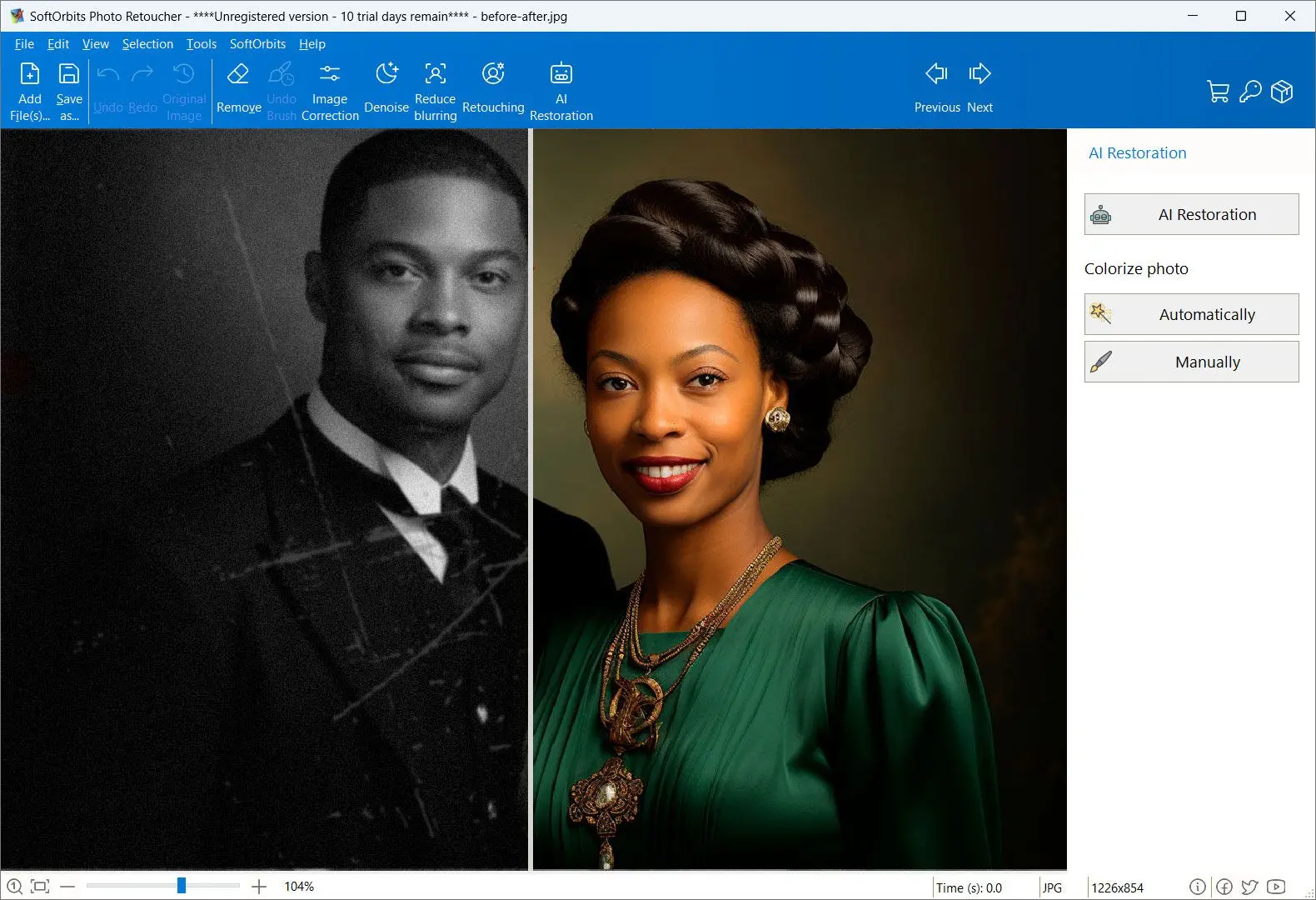
Photo Retoucher Screenshot.
Eugene - CEO at SoftOrbits, Candidate of Technical Sciences, has more than 16 years of expertise in software development, photo and multimedia applications, enhancing and transforming digital images and videos.
📅 Last updated on:  2026-06-23

Picking the best photo editing software for beginners is less about raw power and more about how fast you get a photo you are happy with. Most newcomers do not need a thousand tools. They need to fix the lighting, clean up a blemish, maybe restore an old family photo, and move on. The trouble is that the big names beginners hear first, GIMP and Photoshop, are the two most likely to scare them off. This guide compares nine Windows photo editors for 2026, from free apps to one-time-purchase tools, and tells you who each one actually fits.

Disclosure: SoftOrbits makes Photo Retoucher, our first pick below. We ranked every tool here against the same five criteria, including our own, so you can compare fairly before you download anything.

What you will learn
Apply in 12 min Saves 3 hBeginner

At a glance: 9 beginner photo editors compared

ToolBest forPricePlatform
SoftOrbits Photo RetoucherAutomatic AI fixes and old-photo restorationFree trial, one-time licenseWindows
Photoshop ElementsGuided edits, paid all-rounderOne-timeWindows, Mac
Luminar NeoAI-first looks, clean interfaceOne-time or subscriptionWindows, Mac
Photoscape XFree, simple, batch editsFreeWindows, Mac
Paint.NETLightweight free layers editorFreeWindows
GIMPFree Photoshop-style powerFreeWindows, Mac, Linux
CanvaQuick social and template editsFreemiumBrowser, app
PhotopeaFree browser Photoshop alternativeFree, ad-supportedBrowser
Adobe LightroomGrowing into RAW and presetsSubscriptionWindows, Mac, cloud

How we picked, and what makes a photo editor beginner-friendly

TL;DR

A beginner-friendly editor gets you a good-looking photo fast, costs what you expect, and never punishes you for not knowing the jargon. We weighed ease of use most heavily, then price, then how much the software automates. Windows performance and real user feedback rounded out the five.

We judged every tool against five things a new editor actually cares about. How easy is it to use? You should be able to open a photo and improve it in a few minutes without a tutorial. What does it cost, and how, since a one-time purchase and a monthly subscription are very different commitments for someone editing family photos. How much does the software do for you, given that most beginners want an automatic result before they ever touch a slider. Does it run well on Windows, including older laptops. And what do people actually report on forums and in reviews, rather than what the marketing page claims. ShootProof, in its beginner guide, notes that understanding the basics can take as little as an hour, a fair bar for a tool you should be able to use in your first sitting.

A note on the "Our take" line in each card below. We use SoftOrbits Photo Retoucher ourselves on Windows, and we have spent time in the free and open-source tools here. For the subscription and paid-only apps we did not buy, our read is based on their documentation, track record and user reports, and we say so plainly rather than pretend we ran a three-week test.

The best photo editing software for beginners, reviewed

1. SoftOrbits Photo Retoucher, best for automatic fixes and old photos

Most beginners do not want to learn masking before they fix a photo, and that is the gap SoftOrbits Photo Retoucher fills. It leans on AI to do the heavy lifting. A single click restores a scratched or faded photo, and the same automatic approach handles noise reduction, face reconstruction and colorizing black-and-white photos, all running locally on your Windows PC. It can also wipe out unwanted objects or old date stamps, and it enlarges a photo up to 8x before printing. This is the tool we reach for when the job is "make this old photo look good" rather than "design something from scratch".

Pros:

AI restoration and auto-colorize, applied in one click

Runs locally on Windows, no cloud upload

Batch mode for processing a folder at once

Removes objects and dates without manual masking

Cons:

It is a focused AI editor and restorer, not a full layers-and-masks design suite

Windows only

Verdict: Choose Photo Retoucher if you want good results from old or imperfect photos without a learning curve.
Our take: This is the pick we actually use for restoration and quick cleanups, and the auto-colorize still surprises people. We make it, so weigh that, but the hands-off workflow is the honest reason it sits at the top of a beginner list.

2. Adobe Photoshop Elements - best paid all-rounder with guided edits

Photoshop Elements is the gentle on-ramp Adobe built for people who find full Photoshop intimidating. Its Guided edits walk you through a result step by step, so you learn the move while you make it. Crucially for beginners burned by subscriptions, Elements is a one-time purchase, a point that comes up again and again when people on photography forums ask for something they can pay for once.

Pros:

Guided, step-by-step editing modes

One-time purchase, no subscription

Huge library of free tutorials online

Cons:

Desktop install only, no cloud workflow

Gets feature updates more slowly than Lightroom

Verdict: A safe paid choice if you want to grow your skills with training wheels on.
Our take: Based on its long track record and the guided modes, Elements is the tool we would hand a relative who wants to learn properly without a monthly bill.

3. Luminar Neo - best AI-first editor with a clean interface

Luminar Neo puts AI front and center. It can swap a dull sky, enhance a portrait, or drop an instant "look" that changes the mood of a photo in seconds. Expert Photography points out that Luminar Neo has an uncluttered interface, which is rare for a photo editor, and that matters when panel-overload is a top beginner complaint. It sells as either a one-time purchase or a subscription, so you can avoid the recurring bill if you prefer.

Pros:

AI tools automate edits that are normally fiddly

Clean, calm interface for newcomers

One-time purchase option available

Cons:

Photo organization is weaker than Lightroom

Some advanced features arrive as paid add-ons

Verdict: Pick Luminar Neo if you want dramatic edits fast and value a tidy workspace.
Our take: From its documentation and user reception, this is the editor we would suggest for someone who wants the AI to do the work but still wants a real desktop app.

4. Photoscape X - best free simple editor for everyday photos

Photoscape X is the free tool to recommend when someone just wants to crop a shot, brighten it, slap on a filter, and batch-process a holiday folder without thinking too hard. Its tabbed layout keeps each task in own tab, which feels far less overwhelming than a wall of panels. It will not touch RAW files and has no AI tricks. For JPEGs from a phone or compact camera, though, it is plenty.

Pros:

Completely free

Simple tabbed interface, easy to learn

Batch editing for whole folders

Low system requirements

Cons:

Dated look and feel

No AI tools and weak RAW support

Verdict: A great no-cost starting point for casual, everyday edits.
Our take: We keep Photoscape X around as the "just works" free option; the batch tab alone earns its place.

5. Paint.NET - best lightweight free editor for Windows

Paint.NET is the spiritual upgrade to Microsoft Paint. It stays free, runs natively on Windows, and feels fast even on modest machines, yet it still gives you real layers and a plugin community that adds features as you grow. It loads almost instantly, which is a relief if you have ever watched a heavy editor crawl on an older laptop. There is no Mac or Linux version, so it suits Windows users specifically.

Pros:

Free and very lightweight

Supports layers, unusual for a free simple editor

Active plugin community

Cons:

Windows only

Text cannot be re-edited once placed

Fewer built-in features than GIMP

Verdict: The free pick when you want layers without the bloat.
Our take: Having used it on Windows, Paint.NET is the one we install first on a fresh PC for quick edits.

6. GIMP - most powerful free editor, if you can handle the learning curve

GIMP is the free, open-source heavyweight that genuinely rivals Photoshop on features, with full layers, masks, and channels. The catch is the one beginners feel immediately. CyberLink's roundup is blunt that GIMP's interface is notoriously clunky, and new users should be prepared for a steep learning curve. We list it for the genuine, free power. Nobody would call it easy.

Pros:

Free and open-source, no catch

Full layer, mask and channel toolkit

Available on Windows, Mac and Linux

Cons:

Steep learning curve for total beginners

The floating-window layout confuses newcomers

No AI tools

Verdict: Worth it only if you are willing to invest time before you see results.
Our take: We have spent real hours in GIMP; it rewards patience, but it is the wrong first stop for someone who just wants a quick fix.

7. Canva - best for quick social and template edits

Canva is really a design platform rather than a dedicated photo editor. Even so, when you want to resize an image, drop in some text, and push it into a social-ready template, beginners love how little friction there is. You drag, you drop, you export. Its huge user base is a fair signal of how low the barrier to entry is, since most people never read a manual before making their first Canva graphic.

Pros:

Drag-and-drop templates, almost no learning curve

Works in the browser, nothing to install

Fast exports sized for social media

Cons:

Not a true photo editor, weak on layers and RAW

The best AI tools sit behind the Pro paywall

Verdict: Reach for Canva when the goal is a finished post, not a deep edit.
Our take: For social graphics it is hard to beat; for actually retouching a photo it stops being useful quickly.

8. Photopea - best free browser-based Photoshop alternative

Photopea pulls off a clever trick. It is a Photoshop-style editor that runs entirely in your browser, opens PSD files, and costs nothing. If a friend sends you a layered PSD and you do not own Photoshop, Photopea opens it anyway. The interface deliberately mirrors Photoshop, so any tutorial you find roughly applies.

Pros:

Free and runs in any browser, no install

Opens PSD, AI and XCF files

Full layers and masks

Cons:

Online only, with ads on the free tier

Performance is limited by your browser

Verdict: The free answer when you need Photoshop-style editing on a borrowed or locked-down PC.
Our take: We keep a Photopea tab bookmarked for opening PSDs; it is genuinely useful and genuinely free.

9. Adobe Lightroom - best to grow into RAW and presets

Lightroom is where many photographers eventually land, with a preset-driven workflow, strong RAW handling, and AI tools like Denoise and masking. For a complete beginner it is a bigger jump. Newcomers often stumble over its terminology and the sheer depth of its panels before things click. It also requires a subscription, which is the recurring objection on every forum thread we read.

Pros:

Industry-standard RAW and preset workflow

Excellent learning resources and AI Denoise

Syncs across desktop and mobile

Cons:

Subscription required

Panel depth overwhelms many beginners at first

Verdict: Choose Lightroom when you are ready to commit and grow, not on day one.
Our take: From its track record, Lightroom is the tool to graduate to, not to start with.

Which free photo editors are actually worth it?

TL;DR

For zero cost on Windows, Photoscape X and Paint.NET are the easiest, GIMP and Photopea are the most powerful, and all four export without slapping a watermark on your photo.

Free rarely means crippled these days, though it often means cluttered with upsell prompts. The honest free picks here are Photoscape X and Paint.NET for quick everyday edits. When you need Photoshop-style layers at no cost, GIMP and Photopea are the ones to grab. None of these four force a watermark onto your exports or constantly push you to upgrade, which is more than you can say for many web-based editors that advertise themselves as free. That nagging is a real pattern. Roundups repeatedly flag aggressive upselling and ads in the free tiers of browser tools. If you want automatic cleanups instead of manual editing, our own SoftOrbits Photo Retoucher offers a free trial that lets you test the AI tools before you buy.

What's the closest free alternative to Photoshop?

TL;DR

GIMP is the closest free desktop match for Photoshop's feature set. Photopea mirrors its interface and opens PSD files, right in your browser.

Two free tools split this question. If you want Photoshop-level features on your desktop and will tolerate a different, steeper interface, GIMP is the answer, and it is fully open-source. If you want something that looks and behaves like Photoshop, including opening PSD files, Photopea mirrors the Photoshop layout in a browser tab. Beginners usually find Photopea friendlier because the menus match the tutorials they find online, while GIMP wins if you need to work offline. Neither one costs a cent.

Can a photo editor improve your photos automatically?

TL;DR

Yes. AI editors like SoftOrbits Photo Retoucher and Luminar Neo enhance and restore a photo automatically, so you get a better result without learning sliders.

Automatic enhancement is the feature that changed photo editing for beginners. Instead of nudging a dozen sliders, you let the software analyze the image and fix it. Luminar Neo does this for creative looks and portraits, while our SoftOrbits Photo Retoucher focuses on restoration and repair. It removes dust and scratches, cuts noise, rebuilds damaged faces, and brings color to old black-and-white photos, all on your own PC. If your goal is to clean up imperfect photos rather than design something new, an AI-first tool will save you the most time. You can also pair it with a dedicated utility when you need to wipe out a background or an object.

Photo Retoucher Photo Retoucher

Restore and enhance old photos with SoftOrbits Photo Retoucher, AI-based photo restoration software. Remove scratches, reduce noise, and colorize black-and-white images automatically with AI.

Which editors run well on an older or low-spec PC?

TL;DR

Photoscape X and Paint.NET are the lightest options here and start quickly on modest hardware, while browser tools like Photopea shift the load to a current browser instead of your CPU.

If your laptop is a few years old, the heavyweight editors are the ones most likely to stutter. Photoscape X and Paint.NET were both built to be light, install small, and open fast, which makes them the safe bets on modest hardware. Photopea sidesteps installation entirely by running in the browser, though it still wants a reasonably current one. GIMP and the AI-heavy desktop tools ask more from your machine, so check their system requirements before committing if your PC is older. The good news is that a slower computer no longer locks you out of decent editing.

Subscription or one-time purchase: what should a beginner pick?

TL;DR

If you are unsure, start free or buy once. Subscriptions like Lightroom make sense only when you edit often enough to use them every month.

Cost structure stalls more beginners than any missing feature. A subscription such as Adobe Lightroom keeps you on the latest version and syncs across devices, but it is ongoing cost that feels heavy if you only edit photos now and then. A one-time purchase like Photoshop Elements or a SoftOrbits license costs more upfront and nothing after. Free tools cost nothing at all. Here is our advice for someone just starting. Begin with a free editor or a one-time-purchase tool, and only move to a subscription once you are editing often enough that the monthly fee clearly pays for itself.

How to choose the right editor for you

TL;DR

Match the tool to your job. Free and simple tools cover casual edits. A one-time AI tool handles quick fixes and restoration. GIMP or Photopea give you free Photoshop-style power, and Lightroom is the choice once you are ready to grow.

Skip the temptation to start with full Photoshop; it is the most powerful option, but it is built for professionals and will slow your learning, not speed it. Instead, name your job. If you mostly fix and restore photos, an AI tool like Photo Retoucher gets you there fastest. If you want something free, the simple and layer-based picks above already cover both ends. If you are paying and want guidance, Photoshop Elements holds your hand. And if you already know you want to grow into a serious RAW workflow, Lightroom is the destination, just not the starting line. Pick the smallest tool that does your job, and upgrade only when it stops being enough.

Photo Retoucher Photo Retoucher
Looking for the best photo editing software for beginners? We compare 9 free and paid Windows photo editors by ease of use, price, and AI tools.
Photo Retoucher Screenshot.


🙋Frequently Asked Questions

For automatic results with no learning curve, an AI tool like SoftOrbits Photo Retoucher is the easiest, since it fixes and restores photos for you. For free, Photoscape X has the gentlest interface for everyday edits.

Lightroom is powerful and worth growing into, but many beginners find its terminology and panel depth confusing at first, and it requires a subscription. Start simpler and move to Lightroom once you edit regularly.

For simple edits, Photoscape X and Paint.NET are the easiest free Windows tools. For Photoshop-style power for free, GIMP (desktop) or Photopea (browser) are the strongest, though GIMP has a steeper learning curve.

The basics of a beginner-friendly editor can take about an hour to grasp. Tools with automatic AI shorten that further, while professional editors like Photoshop take much longer to feel comfortable in.

The desktop tools here (Photoscape X, Paint.NET, GIMP) and Photopea export without forced watermarks. Many web-based "free" editors do add watermarks or push you to upgrade, so check before you rely on one.

Yes. The free route covers GIMP and Photopea for layers, plus Photoscape X and Paint.NET for simple edits. Buy once and you own Photoshop Elements, Luminar Neo or our Photo Retoucher for good, with no subscription. A monthly plan is optional, not required, for good editing.

SourcesShootProof beginner photo editing guide - Learning curve and feature criteria for new editorsCyberLink roundup of free photo editors for Windows - GIMP learning curve plus free-tier watermark and upsell patternsExpert Photography on the best editors for beginners - Interface and AI-tool assessment, source of the Luminar Neo noteDPReview forum thread on editors for beginners - Community discussion of GIMP versus Adobe on cost and complexityCoherent Market Insights photo editing market report - Canva user-base figure