After reading this guide, you will:

  1. 1️⃣ Know which photo enlargement software actually rebuilds detail when you upscale, and which just stretches and softens.
  2. 2️⃣ See which enlargers keep halos, ringing, and waxy AI texture under control at 100% zoom.
  3. 3️⃣ Match a tool to your job, whether that is a poster print, a free one-off, or a private offline batch.
Eugene - CEO at SoftOrbits, Candidate of Technical Sciences, has more than 16 years of expertise in software development, photo and multimedia applications, enhancing and transforming digital images and videos.
📅 Last updated on:  2026-07-20

The best photo enlargement software does one hard thing well: it makes a picture bigger while adding believable detail, instead of blowing up the pixels you already have into a soft, mushy mess. That is the whole game. A plain resize doubles the width and doubles the blur with it. A good AI enlarger predicts the edges, the pores, and the fine lines that a bigger canvas needs, then holds back on the halos and the plastic texture that give cheap upscaling away. We tested eight popular tools for this guide, from offline desktop apps to free open-source projects and cloud services. We judged them all on the same two things that matter most when you enlarge: how much real detail the upscale adds, and how well it controls artifacts. Some are brilliant at raw detail and useless offline. Some are free but cap out at 2x. The right pick depends on how big you are going, how private you need to stay, and what you are willing to pay. If you only need to convert a small shot to a larger clean file, the same engine behind our pick also works as an HD photo converter that never uploads your image.

Disclosure: SoftOrbits makes Photo Retoucher, the image enlarger that tops this list. We ranked every tool here, including our own, on the same detail-and-artifact test, so you can compare honestly before you download anything. If you are new to editing and want a gentler start, our pick of the best photo editing software for beginners is a softer landing, and our companion guide to the best photo restoration software covers scratches and fading rather than size.

What you will learn
Apply in 14 min Saves 2 hEasy

Quick comparison

ToolTypeBest forMax upscaleOffline?Pricing model
SoftOrbits Photo RetoucherDesktop (Windows)Offline AI upscale up to 8x8x (800%)YesOne-time / trial
Topaz GigapixelDesktopBest raw detail recovery6x per passYesSubscription
Adobe Super ResolutionDesktop (ACR / Lightroom)RAW files, existing Adobe users2x linear (4x pixels)YesSubscription
UpscaylDesktop (Win/Mac/Linux)Free, private, open source4x per passYesFree (cloud tier extra)
waifu2xWeb / open sourceAnime and line art2xSelf-host onlyFree
BigJPGWebQuick anime or photo upscale16x (paid)NoFree tier + paid
Let's EnhanceWeb (cloud)Batch cloud upscaling16xNoCredits / subscription
ON1 ResizeDesktop / pluginLarge print enlargementsVery large (tiled)YesOne-time or subscription

How we tested and ranked these photo enlargers

TL;DR

We judged every tool on two things above all: how much real detail the upscale adds versus a plain resize, and how well it controls artifacts like halos, ringing, and waxy AI skin. Then we looked at max scale, whether it runs offline, price model, and batch. Detail quality and clean artifacts decided the order.

A "best" list is only useful if you know what it is judged on. Enlarging is a narrower job than general editing, so we led with the two criteria that decide whether an upscale is worth keeping:

  • Upscale detail quality. This is the whole point. A real enlarger looks at the surrounding pixels and reconstructs plausible edges, texture, and fine lines, so a face at 400 percent still reads as a face. A weak one just interpolates, which is a fancy word for stretch-and-blur. We zoomed to 100 percent on hair, eyes, and small text and asked one question: did the tool add detail, or only size?
  • Artifact control. The moment a tool tries to invent detail, it can overshoot. Halos ring around high-contrast edges, ringing shimmers along lines, and skin turns into that plastic, poreless AI look. We rewarded tools that add detail without leaving these tells, and marked down the ones that traded blur for a different kind of ugliness.
  • Maximum scale. Some jobs need 2x, a poster needs 6x or more. A 2x-only tool is fine for a screen crop and useless for a wall print.
  • Offline and privacy. Family and client images should not have to leave your PC. We tracked which tools process locally and which upload to a server.
  • Price and batch. One-time versus subscription matters for an occasional job, and a folder of images should not mean feeding them one at a time.

How we tested. We build Photo Retoucher, so we upscale images with it constantly. For this guide we took a small batch of low-resolution originals (a soft conference portrait, a 500 by 500 product shot, and a scanned line drawing) and ran each one through our own tool on a plain six-core desktop, an Intel i5-11400F with no separate graphics card, watching what the AI reconstructed and where it overshot. Then I put the same originals through every other tool myself, using the free trial or free tier where one existed, and reading the vendor docs and model cards for the numbers I could not measure by hand. Where a watermark, a credit wall, or a 2x cap stopped me from pushing a tool, I say so instead of glossing over it. Exact prices we leave out, since they move.

The 8 best photo enlargement software tools, reviewed

1. SoftOrbits Photo Retoucher - best offline AI enlarger for Windows

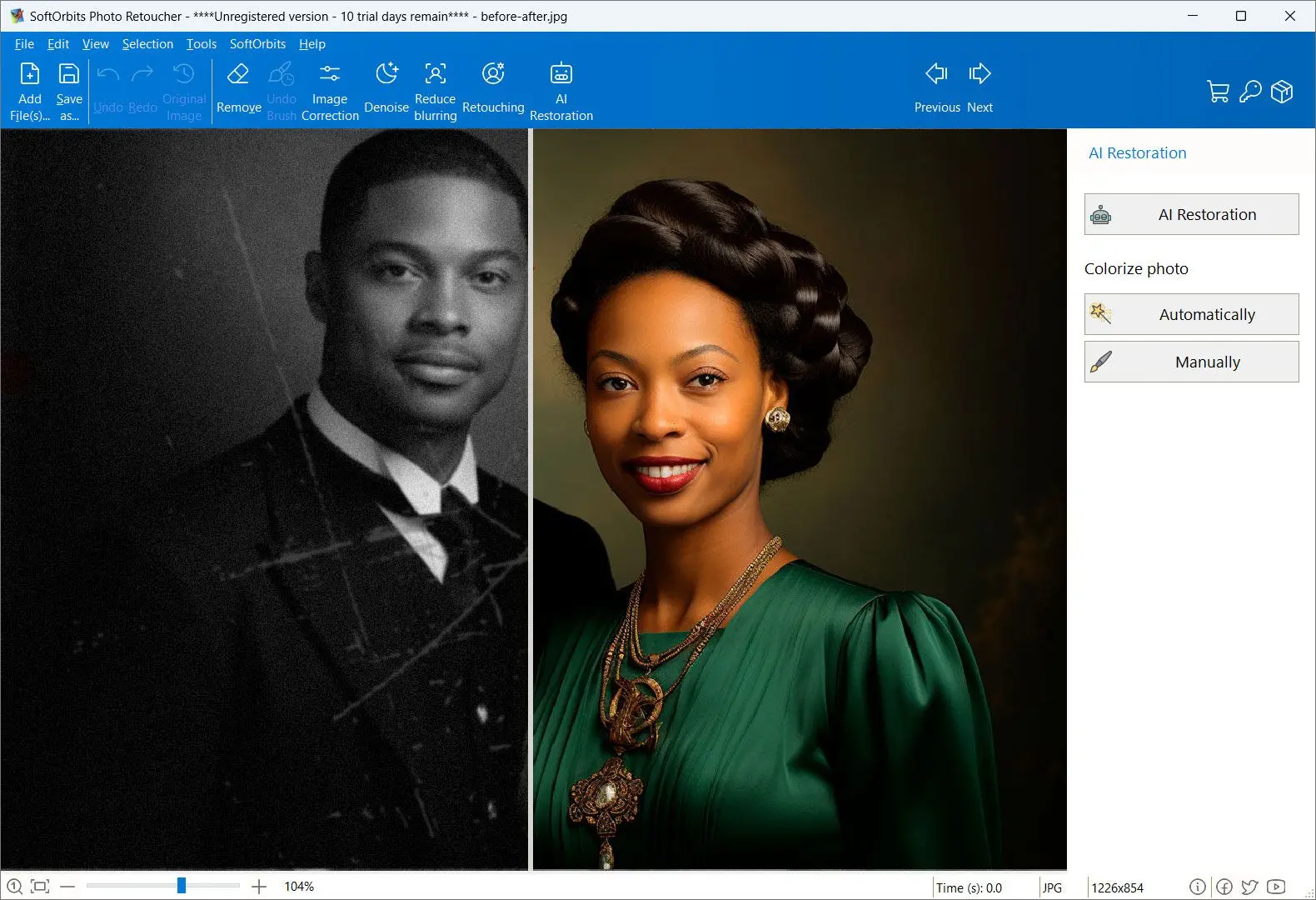
SoftOrbits Photo Retoucher is a Windows desktop app and our pick for photo enlargement software. It upscales with AI presets at 2x, 4x, and 8x, so a small original can grow up to 800 percent for print or tight cropping, and every pixel stays on your PC with no upload. Under the hood it runs LapSRN super-resolution models for the clean AI enlarge, plus RealESRGAN for noise control on grainier sources, both compiled in native C++ so there is no heavy Python runtime to babysit. On a machine with a compatible GPU it uses DirectML acceleration, and it falls back to CPU cleanly when there is no card, which is exactly how we ran it. The reason it tops this list is not one killer model. It is that the AI enlarge sits inside a real editor, so when the upscale nails the job you export, and when it leaves a soft patch you switch to the manual tools and the touch-up brush and fix it by hand. It opens the usual formats (JPEG, PNG, WebP, HEIC) and runs a whole folder in Batch Mode, which matters when you inherit a set of small scans.

4.5 / 5
average rating for Photo Retoucher from 1,416 buyers on our product page
Source

Enlarging with a plain resize

Bump a 500 by 500 shot to 2000 by 2000 with bicubic resize and the size quadruples along with the blur. Edges go soft, text smears, and any noise gets bigger too. You end up sharpening afterward, which just adds halos.

With Photo Retoucher AI enlarge

Pick the 4x preset and the model reconstructs edges and texture instead of duplicating pixels, then holds noise and halos down. Fix any soft patch with the manual brush, and run the rest of the folder in one batch.

Here is what actually happened when we ran our own small batch. On the 500 by 500 product shot, the 4x AI enlarge held the edges of the packaging text readable where a plain resize turned them to mush, which is the single thing that sold us on the preset. The soft conference portrait was the honest test. AI upscaling is strongest when there is real detail to reconstruct, and this face was already blurry at the source, so the 4x pass sharpened the eyes and lashes well but could not invent skin pores that the camera never captured. That is the truth about every enlarger on this list, ours included, and the tool that pretends otherwise is the one to distrust. The scanned line drawing came out cleanest of the three, since crisp black lines on white are the easiest thing for a super-resolution model to rebuild. Where the AI left a slightly soft corner on the portrait, the manual sharpen and clone tools closed it in a few seconds. The AI does the heavy lifting, you keep control of the last ten percent, and it never leaves your machine.

Pros:

Offline AI enlarge at 2x, 4x, and 8x, up to 800 percent, no upload

Native C++ engine with GPU acceleration and clean CPU fallback

Sits inside a full editor, so you can correct a soft upscale by hand

Batch Mode for a whole folder, one-time license, no subscription

Cons:

Windows only, no Mac version

Not a pure detail-recovery specialist like Gigapixel on the hardest sources

Very small or badly damaged originals still hit the ceiling every enlarger shares

Verdict: The best default for anyone on Windows who wants private, owned AI upscaling that lives inside a real editor.
Our take: We make this one, so treat that openly. In day-to-day use the part we lean on is the 4x preset plus the manual brush right after, because that click-and-correct loop is what turns a decent upscale into a keeper.

Photo Retoucher Photo Retoucher

Restore and enhance old photos with SoftOrbits Photo Retoucher, AI-based photo restoration software. Remove scratches, reduce noise, and colorize black-and-white images automatically with AI.

2. Topaz Gigapixel - best raw detail recovery

Gigapixel is the tool photographers name first when detail is the whole job, and the reputation is earned. It ships a stack of specialized AI models, Standard, High Fidelity, Low Resolution, Text and Shapes, and more, so you can match the model to the source instead of forcing one algorithm on everything. Per the official product page it upscales from 0.5x up to 6x in a single pass, all rendered locally so files never leave your computer. The catch is the bill. Topaz moved Gigapixel to a subscription-first model in October 2025, so the perpetual license that occasional users relied on is no longer the headline option.

up to 6x
single-pass upscale in Topaz Gigapixel, across nine specialized AI models, rendered locally
Source

Pros:

Top-tier detail reconstruction, especially on faces and fine texture

Nine specialized models to match the source

Runs fully offline once installed

Cons:

Subscription-first since October 2025, no headline perpetual license

Heavy on system resources

Overkill if you only enlarge occasionally

Verdict: Pick Gigapixel when detail recovery is everything and you will use it enough to justify a yearly bill.
My take: The detail is the part that stuck with me. I pushed a soft portrait to 4x and the eyelashes and hair came back with texture that almost nothing else here matches, no waxy skin. Then I hit the wall every casual user hits: it is a rented tool now, and for one poster I did not want a subscription running in the background.

3. Adobe Super Resolution - best for RAW files and existing Adobe users

If you already live in Lightroom or Camera Raw, Super Resolution is the enlarger you already own. You right-click a photo, choose Enhance, tick Super Resolution, and Adobe rebuilds it at twice the linear resolution. As the Adobe help docs spell out, that is two times the width and two times the height, or four times the total pixel count, so a 12-megapixel frame becomes a 48-megapixel one. It is strongest on RAW files, where it has the most data to work with, and weaker on a small JPEG. The limits are the scope and the price: it does a single fixed 2x jump, not the 6x or 8x the dedicated tools reach, and it only exists inside a Creative Cloud subscription.

Pros:

Excellent quality on RAW files

Already included if you pay for Creative Cloud

Sits right inside your existing edit workflow

Cons:

Single fixed 2x linear jump, no higher scale

Best results really need RAW, not JPEG

Subscription only

Verdict: The obvious pick for photographers already in Lightroom who shoot RAW and need a clean 2x.
My take: On a RAW file the result was genuinely clean, four times the pixels with edges that held up. The contrast came when I fed it a small JPEG: the same feature did far less, because there was less real data to rebuild from, and 2x is as far as it goes.

4. Upscayl - best free and open-source enlarger

Upscayl surprised me. It is completely free, open source, and runs entirely on your own machine, and it is genuinely good. It is built on Real-ESRGAN and ships several models (UltraSharp, Remacri, High Fidelity and more), so it is not a toy. Per its GitHub project it upscales up to 4x per pass with images staying local, no account and no cloud, which is a rare combination at zero cost. The one real requirement is a Vulkan-compatible GPU for usable speed, so it is happiest on a machine with a modern graphics card rather than a thin laptop.

4x per pass, 0 cost
Upscayl is free and open source, upscaling up to 4x locally with no cloud upload
Source

Pros:

Free and open source, no watermark, no account

Runs locally, images never upload

Solid Real-ESRGAN quality with several models

Cons:

Needs a Vulkan-capable GPU for usable speed

No integrated editor to fix a soft upscale by hand

Rougher, more technical interface than the paid apps

Verdict: The best free pick for anyone with a decent GPU who wants private, no-cost upscaling.
My take: I expected a rough hobby app and got a real one. On a photo with a capable GPU it held detail nearly as well as tools that charge monthly. The trade is that it is upscale-only, so when a corner came out soft there was no brush to fix it, just another pass.

5. waifu2x - best for anime and line art

waifu2x is the veteran, and it is still the right answer for one specific thing: anime-style art and clean line drawings. It reduces noise and upscales in one shot, and its open-source project is clear about the ceiling. It supports 2x scaling only, with adjustable denoise from level 0 to 3. Bigger results come from running the 2x model again, not from a native higher factor. For flat colors and hard outlines it is excellent. For a detailed photo of a real face, a modern Real-ESRGAN tool will beat it.

2x
maximum native upscale in waifu2x, with denoise levels 0 to 3, tuned for anime and line art
Source

Pros:

Outstanding on anime, illustration, and clean line art

Combined denoise and upscale, free

Mature, well understood, open source

Cons:

2x native cap, higher scales mean repeated passes

Weak on detailed photographs of real subjects

The public web versions upload your image

Verdict: The go-to for illustration and line art, not for photographic enlargement.
My take: One job, done beautifully. I ran a scanned line drawing through it and the outlines came out crisp and clean with the paper noise gone, better than any general tool managed on that file. Hand it a real photo and its age shows.

6. BigJPG - easiest web upscaler for a quick job

Would you rather not install anything? BigJPG is the browser answer. It uses a deep convolutional network in the waifu2x lineage, so it leans toward anime and illustration but handles photos too, and you can push it to high scales on the paid tier while the free tier caps dimensions and adds a queue. It is fast and needs zero setup. The trade-offs are the ones every web tool carries: your image uploads to a server, the free tier is limited, and you are trusting a service with whatever you feed it.

Pros:

No install, works in any browser

Good on anime and illustration, decent on photos

High scale factors on the paid tier

Cons:

Uploads your image to a server

Free tier caps size and adds a queue

No batch control or manual fixes

Verdict: Fine for a one-off upscale of a non-private image when you do not want to install anything.
My take: I dropped in a small illustration and had a 4x result in under a minute with no signup, which is the appeal. The free tier size cap and the fact that my image left my machine are why it is a convenience tool, not a workhorse.

7. Let's Enhance - cloud batch upscaling

Let's Enhance is the cloud-service take on enlarging. You upload, it processes on its own servers, and it markets upscaling to high resolution with batch support, aimed at e-commerce and marketing teams pushing many product shots at once. The convenience is real: no local hardware needed, and it scales to a queue of images. The cost is the usual cloud math. It runs on credits or a subscription, and every image you enlarge is an image you have uploaded to a third party.

Pros:

No local hardware needed, runs in the cloud

Batch-friendly for large sets

Aimed at e-commerce and marketing volume

Cons:

Every image uploads to a server

Credit or subscription cost adds up per image

No offline option at all

Verdict: Reasonable for a business pushing volume through the cloud, wrong for private or occasional work.
My take: I ran a product shot through the free allowance and the result was clean and usable. Two things kept it off the top for me: the credits tick down fast on a real batch, and the whole point of the tool is that your images live on someone else's server.

8. ON1 Resize - best for very large print enlargements

ON1 Resize (the descendant of Genuine Fractals) is the specialist for going big on paper. It uses a tiling approach built for extreme enlargements, so it is the tool people reach for when the output is a banner or a gallery print rather than a screen. It runs standalone or as a plugin, on Windows and Mac, and it can be owned with a one-time license or rented. It is not an AI-first detail recoverer in the Gigapixel sense, so on a soft small source a modern AI tool often adds more believable texture, but for controlled, very large print scaling it remains a trusted name.

Pros:

Built for very large print enlargements

Standalone or plugin, Windows and Mac

One-time license option still available

Cons:

Less AI-driven detail invention than Gigapixel on soft sources

Print-scaling focus is overkill for screen-size work

Interface leans professional

Verdict: The pick when your output is a large physical print and you want proven, controlled scaling.
My take: This is a print tool, and it acts like one. I set a target print size and it enlarged with steady, controlled results, no wild artifacts. For a web-size crop it was more machine than I needed.

Which enlargers actually add detail instead of just stretching pixels?

TL;DR

The one feature that separates a real enlarger from a resize is detail reconstruction: the AI predicts edges and texture a bigger canvas needs, rather than duplicating the pixels you have. Gigapixel and our Photo Retoucher rebuild the most, Upscayl close behind. A plain resize or Preview only interpolates. No tool can invent detail that was never captured.

This is the single feature that should drive your pick, so it earns its own section. When you enlarge a photo, software has to decide what to put in the new pixels it is creating. There are two ways to do it. Interpolation, the old way, averages the neighboring pixels, which is fast and always available and always a little soft, because it is guessing the safe middle value. Detail reconstruction, the AI way, was trained on millions of images to predict what a real edge, pore, or strand of hair should look like at the larger size, and paints that in. That is why a good AI enlarge of a 500 by 500 shot can look sharp at 2000 by 2000 while a bicubic resize of the same file looks like a soft balloon. But reconstruction has a hard limit worth stating plainly, because half the disappointed reviews online come from missing it: the AI can only rebuild detail that is plausible from what is there. Feed it a face that was already a blurry smudge and it will sharpen the shape, not conjure the person's actual pores. On top of that sits artifact control, the second half of the job. The same model that invents detail can overshoot into halos around high-contrast edges, ringing along lines, or that poreless plastic-skin look. The tools we ranked highest add detail and keep those tells down at the same time. If your goal is sharpening a slightly soft shot rather than making it bigger, a focused image sharpening pass is the better first move.

Best free photo enlargement software: what you really get

TL;DR

Free photo enlargement software is real and worth trying. Upscayl is the standout: open source, offline, and genuinely good if you have a GPU. waifu2x is excellent for line art. Web tools like BigJPG and Fotor give a quick free upscale but watermark or cap output and upload your image. Free is a fine first try; the ceilings are scale, batch, and privacy.

Want to spend nothing? You have better options in 2026 than you did a few years ago, and I put the same small originals through the free routes to see where each one lands. Upscayl is the one to try first: it is free, open source, runs entirely offline, and on a machine with a Vulkan-capable GPU it produced results close to the paid desktop tools, with no watermark and no upload. waifu2x is the free champion for anime and clean line art, capped at 2x but excellent inside that lane. On the web, BigJPG and Fotor's free tier both gave a quick browser upscale, but the pattern is consistent: a size cap, a queue, sometimes a watermark, and your image uploaded to a server. GIMP is the free, fully offline desktop option, but its resize is plain interpolation with no AI reconstruction, so it enlarges without adding real detail. The honest limits of the free route stay steady. You get lower ceilings on scale, weaker batch handling, and, for the web tools, the privacy cost of uploading. For an occasional non-private image, free is a perfectly good answer. For a private batch or a large print, an offline tool you own will save you re-doing the job. When you only need to make a folder smaller rather than larger, a batch picture resizer is the faster route than any AI upscaler.

Enlarging for print: how big can you really go?

TL;DR

For print, start from the largest clean original you have and enlarge in moderate steps rather than one giant jump. A 2x to 4x AI upscale holds up well for most prints; beyond that, inspect eyes, hair, and edges at full zoom for halos and mush. Match final pixels to your print size and DPI, and export once so you do not stack JPEG artifacts.

Print is where enlargement earns its keep, and where the ceiling bites hardest. The rule that has held up across every tool is to start from the largest clean original you can get and to enlarge in moderate steps. A 2x or 4x AI upscale from a solid source usually holds up beautifully at print size. A single 8x jump from a tiny, soft file will show its seams no matter which tool you use, because the AI is being asked to invent most of the picture. Before you send anything to a vendor, zoom to 100 percent and hunt the failure modes: halos ringing around high-contrast edges, a plastic sheen on skin, and mush in fine detail like hair or foliage. If you see them, drop back a step or switch models. Match your final pixel dimensions to the print size and DPI your print shop specifies, and export once at the end. Every extra JPEG save on the way stacks compression artifacts that no enlarger can undo. For a poster from a clean source, Gigapixel or ON1 Resize give the most controlled results; for a private print from a small original on Windows, our own Photo Retoucher keeps the whole job offline.

Offline vs cloud: which photo enlargers keep your images private?

TL;DR

If privacy matters, choose a desktop enlarger that processes locally. SoftOrbits Photo Retoucher, Topaz Gigapixel, Adobe Super Resolution, Upscayl, and ON1 Resize all run on your own machine. The web tools (BigJPG, Let's Enhance, and the public waifu2x and Fotor pages) upload your image to a server, which is the wrong trade for client work or personal photos.

Offline versus cloud is the cleanest dividing line in this category, just as it is in restoration. Of the eight tools here, the five desktop apps do the work on your own machine, so a client's product shots or a personal photo never leave the building. The web services need to upload. That is not a hypothetical concern for anyone handling images under a client agreement or images of family. Upscayl makes a point of it in its own project notes, that images stay local so you can upscale confidential assets without sending files to the cloud, and that local-first stance is exactly why it and the other desktop tools sit above the web services for private work. For a throwaway image where you just want zero install, a web upscaler is a reasonable trade. For anything you would not email to a stranger, keep it on your PC.

Also considered: enlargers that did not make the cut

TL;DR

We looked past the top eight too. VanceAI, Fotor and Nero AI, GIMP, and the built-in Windows and macOS resizers each fell short for real enlargement work, and here is the honest reason for each.

Eight picks is a shortlist, not the whole market. These are the tools we tried or read up on and left off, with the reason each one dropped:

  • VanceAI. A capable cloud upscaler with a restoration model too, but it runs on a credit system in the cloud, so every batch uploads your images and spends credits. That is the opposite of the private, own-it-once route most people want. We cover its enlarger separately.
  • Fotor and Nero AI. Both give a fast, free browser upscale that is fine for a quick social crop, but they watermark or cap the free output and upload your image, so they land as convenience tools rather than finishers.
  • GIMP. Free and fully offline, which we like, but its Scale Image is plain interpolation with no AI detail reconstruction, so it enlarges the pixels you have without adding new detail. Good for a mild resize, not for real upscaling.
  • Windows Photos and macOS Preview. The resizers already built into your system. Fine for shrinking an image or a tiny bump, but they only interpolate, so a real enlargement comes out soft.

How to choose the right photo enlargement software

TL;DR

Match the tool to the job. Use offline AI (Photo Retoucher) for private Windows upscaling, Gigapixel for maximum detail, Adobe Super Resolution if you already shoot RAW in Lightroom, Upscayl for free and private, waifu2x for line art, and a web tool only for a quick non-private one-off.

Work backward from what you have and where it is going. The two questions that decide most of it are whether the images need to stay off the cloud, and whether you are doing this once or often. Use the scorecard to see the trade-offs at a glance, then read the persona that fits you:

ToolDetail qualityArtifact controlOfflineBest use
Photo RetoucherHighHighYesPrivate Windows upscaling in a real editor
Topaz GigapixelHighestHighYesMaximum detail recovery
Adobe Super ResolutionHigh (RAW)HighYesRAW files, existing Adobe users
UpscaylHighMediumYesFree and private with a GPU
waifu2xMedium (photos)High (art)Self-hostAnime and line art
BigJPG / Let's EnhanceMediumMediumNoQuick or batch cloud jobs
ON1 ResizeMediumHighYesVery large print enlargements

The shortest version is to match the tool to who you are:

  • The Windows user with private images to enlarge. You want AI upscaling that stays offline and lets you fix a soft result by hand, which is why Photo Retoucher sits at the top for this profile. Free tools upload or lack an editor; Gigapixel is rented.
  • The detail purist enlarging soft or low-resolution photos. Gigapixel reconstructs the most believable detail on the hardest sources, as long as you will use it enough to justify a yearly subscription.
  • The photographer already in Lightroom shooting RAW. Adobe Super Resolution is already in your kit and excellent on RAW, so long as a fixed 2x is enough for the print you have in mind.
  • The no-budget hobbyist with a decent GPU. Upscayl gives free, offline, no-watermark upscaling that punches well above its price, with the one requirement of a Vulkan-capable graphics card.
  • The illustrator or anime artist. waifu2x remains the cleanest free upscaler for line art and flat color, capped at 2x but excellent inside that lane.

Photo Retoucher Photo Retoucher
Compare the 8 best photo enlargement software tools for 2026: upscale images with AI, keep edges clean and artifact-free, stay offline, and pick free or paid.


🙋Frequently Asked Questions

For free, offline upscaling with real AI detail, Upscayl is the standout, as long as you have a Vulkan-capable GPU, and it never uploads your image. waifu2x is the best free pick for anime and line art. Web tools like BigJPG and Fotor give a quick free upscale but usually cap size, add a watermark, or upload your image, so free is a great first try rather than a finisher for a large or private job.

Desktop apps process locally and keep your images on your PC. SoftOrbits Photo Retoucher, Topaz Gigapixel, Adobe Super Resolution, Upscayl, and ON1 Resize all run offline. Web services such as BigJPG and Let's Enhance, and the public waifu2x and Fotor pages, upload your image to a server.

Use AI image enlargement software that reconstructs detail instead of only duplicating pixels, start from the largest clean original you have, and enlarge in moderate steps rather than one giant jump. Then inspect eyes, hair, and edges at 100 percent zoom for halos or mush. No tool can invent true optical detail the camera never captured, so a very small or heavily compressed source still hits a ceiling.

It depends on the quality of the original, not just the tool. A clean source enlarged 2x to 4x with a good AI tool usually prints well; pushing 6x or 8x from a small, soft file will show artifacts no matter which software you use. Match the final pixel dimensions to your print size and the DPI your print shop specifies, and export once so you do not stack JPEG compression.

No. Topaz Gigapixel and Adobe Super Resolution are subscription-based, but SoftOrbits Photo Retoucher and ON1 Resize can be owned with a one-time license, and Upscayl is free and open source. For an occasional enlargement job, owning the software once or using a free offline tool is usually the better value than a recurring bill.

Sources

  • Topaz Gigapixel. Official product page; up to 6x single-pass upscale, nine AI models, local rendering, subscription-first pricing.
  • Adobe Camera Raw Enhance docs. Super Resolution doubles linear resolution (2x width and height, 4x pixels).
  • Upscayl on GitHub. Free and open-source AI upscaler, Real-ESRGAN models, up to 4x per pass, runs locally.
  • waifu2x on GitHub. 2x native upscale with denoise levels 0 to 3, tuned for anime and line art.
  • ON1 Resize. Dedicated print-enlargement tool with tiled scaling, standalone or plugin.