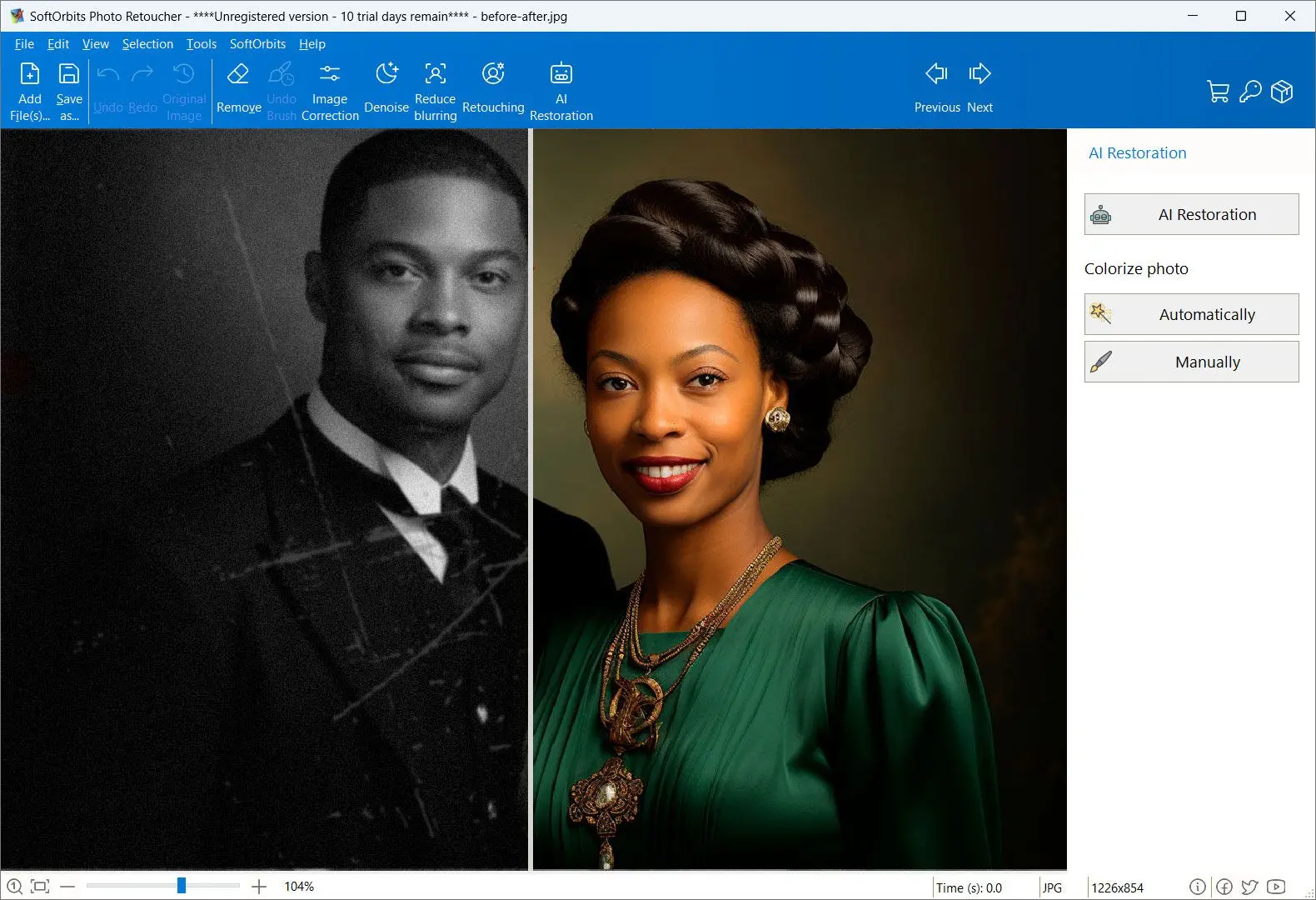
Key Features
- User-friendly interface designed for beginners.
- One-click old photo recovery including dust and scratch removal and colorization, plus face restoration.
- Unlike many AI-only tools, it preserves face detail when you dial the effect back.
- Includes both automatic and manual tools for flexibility.
- Additional restoration features such as blemish removal and color correction.
Detailed Features
After removing scratches, stains, date stamps, and similar flaws, you can keep working in the same editing program.
Image Correction
No photo can be restored entirely without slight brightness, contrast, and white balance adjustments.
Clicking Image Correction in the toolbar opens lighting controls such as contrast, tint, gamma, and temperature.
You will not need another app just to fix exposure.
There is also an Auto Correction button where the program adjusts parameters for better exposure and white balance.
Colorize Option
Photo Retoucher includes an automatic colorize option under the tools on top.
For black-and-white images, the program analyzes regions and fills them with plausible color. Adding color to a faded print often brings the scene back to life.
Manual Cleaning Tools
Some areas may not clear in one pass on heavily damaged scans. In those cases, try the following three options for restoration, which give finer control over how each spot is removed:
Clone Stamp Tool
Clone stamp features help photographers copy one part of the image over another. You can duplicate texture or cover a flaw with a clean patch.
Photo Retoucher places a Clone stamp tool in the toolbar. You choose the source area that will hide the scratch or stain.
How to use clone stamp:
- After opening the photo, select the Clone Stamp icon from the toolbar. Your mouse pointer will look like a cross.
- Select the good area that will be cloned to cover the part you want to fix. Before that selection, adjust the brush size. Increase the brush size when you need to clone a large region, such as shells along a shoreline.
- Hold Alt, left-click to set the source, then brush over the area. For old photo restoration, pick a clean area that matches the background near the damage.
- When you are done sampling, stamp over the bad region. Release Alt, position the brush, and paint over the flaw.
- As you paint, the sampled area is repeated over the damaged region.
This method works well for minor scratches that cross different parts of the frame. By changing the clone source to follow background color, you can erase the scratch in small steps.
Smudge Tool
You can use the Smudge tool to blend a problem patch with its surroundings.
A few clicks on the affected area can soften the spot so it sits more naturally in the background. Once an old print is clean, some people convert photo to sketch for a framed keepsake. Others reach for a photo to line art converter to get a clean outline.
 Photo Retoucher