Main Features of VanceAI
One credit pool covers the whole suite. Enhancement, upscaling and restoration sit next to colorization and denoising. Background removal is in there too, plus a separate video line. Batch processing and PSD export are locked to paid plans.
Here is what the suite actually gives you.
noise reduction and sharpening in a single pass, with a color-correction step on top.
VanceAI advertises upscaling of up to 40x on its online enlarger, which is a vendor claim and not something we measured.
takes scratches and tears out of old scans and lifts the sepia cast. A face-focused model handles skin and hair on portraits.
automatic colorization of black-and-white images, which you can run on an already-restored photo in the same workspace.
strips sensor noise and compression artifacts, sold as its own tool with its own credit cost, where a desktop photo noise reduction software charges nothing per image.
subject cutout, the same job our photo background remover software does on the desktop.
multiple images in one run, available on paid plans only.
paid plans can export a layered file so you can keep editing in Photoshop.
a separate product line for video upscaling and denoising, with slow motion and SDR to HDR conversion.
the Windows desktop app, marketed as unlimited processing through every model with no credits required on the lifetime tier.
One thing to check before you buy is the upload limit. Independent reviewers report it differently. One cites a 3000 by 3000 pixel cap with no RAW support in the web tool. Another quotes 34 megapixels. A third talks about a 5,000 pixel long edge for JPG and TIFF. That spread probably reflects different tools inside the suite, so confirm the ceiling for exact tool you plan to use.
Pricing and Performance Review
The free plan gives you 3 credits a month, which is barely a test. Paid plans run from $9.90 to $19.90 a month on credits, pay-as-you-go starts at $4.95 for 100 credits, and the desktop app is a separate $129.90 lifetime purchase. Third-party ratings swing from 4.3 out of 5 down to 2.3 out of 5, depending on where you look.
VanceAI runs on credits, not on tools. One credit is roughly one processed image, and the same pool works across the whole suite. That sounds flexible until you realize you cannot predict easily what a batch of 40 scans will cost you.
| Plan | Price | What you get |
|---|---|---|
| Free | $0 | 3 credits per month (one review reports 4 for the Image Enhancer specifically); limited output |
| Pay-as-you-go | $4.95 / 100 credits, up to $17.95 / 1000 | One-time purchase, credits valid for a year, no subscription attached |
| Basic subscription | $9.90 / month | Reported as 100 credits with rollover in one source and 200 credits in another; verify before you buy |
| Pro subscription | $19.90 / month | 500 credits, full access to the 20-plus tools |
| VanceAI PC (desktop) | $39.90 / month, $99.90 / year, $129.90 lifetime | Models run locally, no credits on the lifetime tier, 14-day money-back window advertised |
Look at that last row for a moment. The monthly desktop price is four times the Pro web plan, and the lifetime option costs about as much as seven months of Pro. If local processing is what you want, the lifetime tier is the only reasonable option, and even then you are betting on a company honoring a lifetime promise.
On quality, the picture is genuinely split. VanceAI holds a 4.3 out of 5 on G2 from 62 reviews, and its Photo Restorer scores 9.4 for ease of use there, though from a sample of only 14 reviews. Trustpilot rates the company "Excellent" in the 4.3 to 4.6 range depending on the snapshot.
Then you check a different aggregator and the rating drops sharply. On SmartCustomer, formerly Sitejabber, VanceAI sits at 2.3 out of 5, with one reviewer writing that wait times run "regularly more than 10 minutes" and that over a month none of their requests "have functioned altogether." The sample there is tiny, only three reviews, so we would not treat it as the truth either. What it does tell you is that the happy majority and the burned minority are describing different products, and you cannot know which one you will get until your card is charged.
Speed is usually fine. Reviewers call it fast for single images, and batch runs are its selling point. The counter-evidence is specific rather than vague. At least one buyer reports processing that ran past ten minutes or never finished at all. The desktop app also has real hardware requirements. The floor is an Intel 4th-generation CPU with 8 GB of RAM and a GTX 750 Ti. The recommended spec climbs to an i7 with 16 GB and an RTX card.
Covers restoration and colorization from the same credit pool that pays for enlargements
Batch processing handles a folder of scans in one run
Vendor policy says uploads are encrypted and auto-deleted within 24 hours
A desktop app exists for people who want local processing
The credit system is hard to budget for, especially on a large batch
Free tier of 3 credits is too thin to evaluate the tool properly
Faces and busy backgrounds come back inconsistent, per multiple reviewers
Cancellation and refund friction is a recurring theme in buyer complaints
Go to the VanceAI Photo Restorer or Image Enhancer page and click Upload Image to select your file.
Pick the options that match the damage on your scan, from a torn corner through to fading and color cast. Turn on face enhancement if the photo has portraits in it.
Hit Start to Process. In the desktop app you pick the tool first, then drag the file into the window.
The desktop app exposes more control than the web tool. You get a scale factor and a model picker, plus sliders for blur and noise. A soft scan that needs real deblurring is a different job, and dedicated unblur image software handles it better than an upscale slider does.
VanceAI shows an automatic before-and-after comparison when the job finishes.
Switch on Colorize in the same workspace to add color to a restored black-and-white photo. That is a second operation, so budget a second credit.
Press Download Image to save it. PSD export is available on paid plans. Credits are deducted once per processed image, so re-downloading the same result does not cost extra.

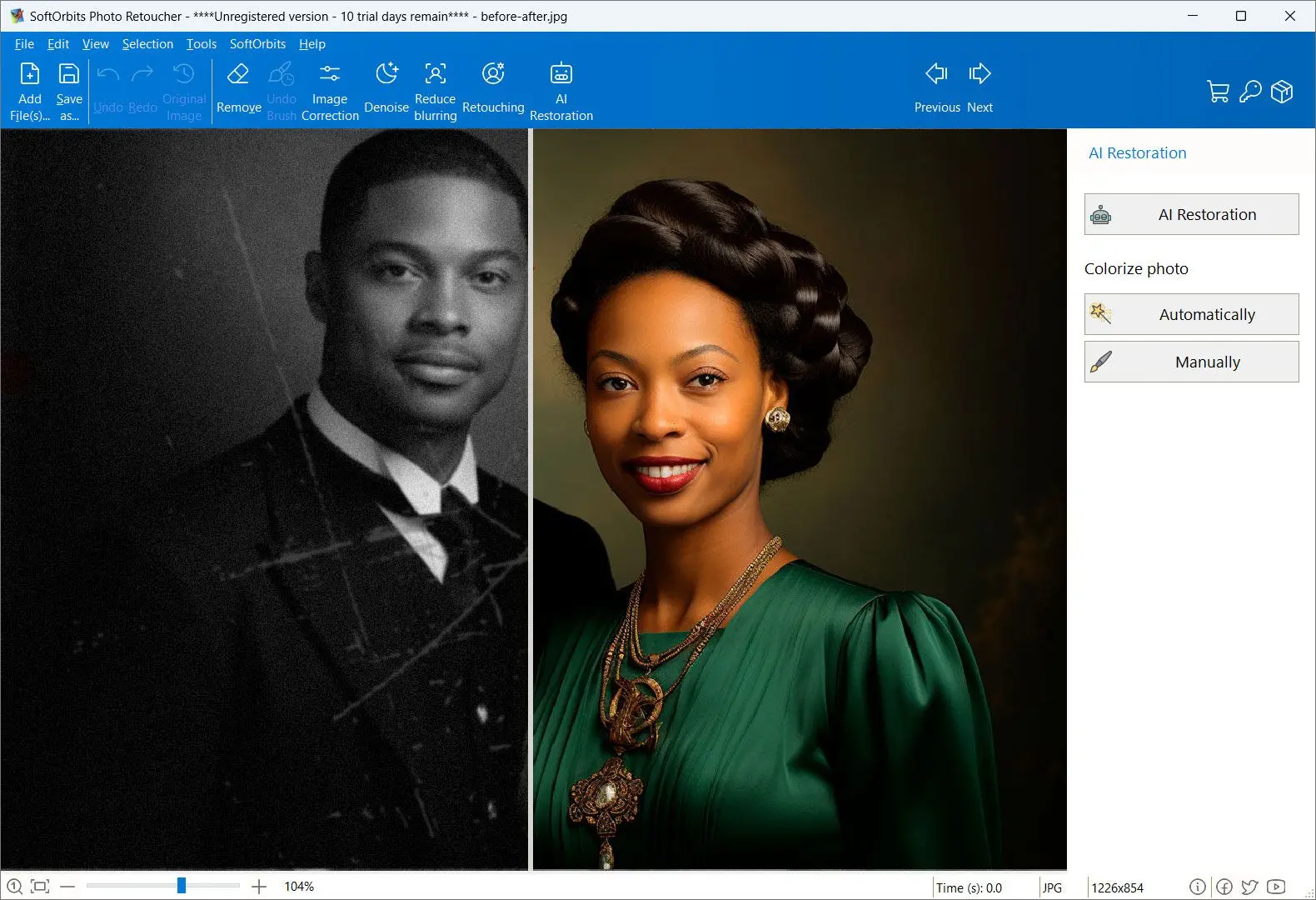
Restore and enhance old photos with SoftOrbits Photo Retoucher, AI-based photo restoration software. Remove scratches, reduce noise, and colorize black-and-white images automatically with AI.
Where VanceAI falls short
The complaints cluster around billing, support and consistency. Buyers report missing cancel buttons and ignored refund requests inside the advertised window, plus faces that come back distorted. Behind all of it sits the structural issue. On the web plans, your photos leave your computer.
Start with billing, because that is where the complaints concentrate. On the company's Trustpilot page, one reviewer says there is no clear cancel-plan button anywhere in the dashboard or billing page, and that they contacted support five or six times about cancellation while the charges kept landing. Another paid 85 euros, requested a refund inside the advertised money-back window, and reports getting neither the refund nor a straight answer.
That pattern is what turns a decent tool into a bad purchase. A photo enhancer that occassionally garbles a face is just annoying. One you cannot cancel is a different problem.
Quality complaints exist too, and they are specific. One buyer who spent $33.99 on credits reports that the AI distorted faces, garbled text, and added artifacts. Independent reviewers echo the softer version of this: the editorial team at Tools for Humans scored it 3.5 out of 5 and flagged inconsistent performance on landscapes and complex backgrounds, and a comparison piece on Rangy lists lower face quality than competitors as VanceAI's weak spot next to Topaz.
The desktop app is not automatically the answer either. In a German-language thread on r/KI_Welt, a user reports the desktop trial simply hanging while loading the AI model, with a support ticket that went unanswered. They wanted to buy it. They could not get it to run. Over on r/aiArt, someone weighing the lifetime plan mentions threads from people who say their monthly credits never arrived.
And then there is the credit model itself, which even friendly reviews call out. The team behind 4DDiG's VanceAI review put it plainly, calling the pricing plan with its credit system "a bit confusing for beginners." They were not being unkind. They were describing a checkout you have to do arithmetic for.
Marketing and practice do not line up here, and that gap is the thing to watch. The site advertises a money-back window; buyers report refund requests inside that window going unanswered. The lifetime desktop tier promises unlimited use; forum posts claim licenses that stopped working. Pricing pages list credit counts that two independent reviews record differently. None of this makes VanceAI a scam. It does mean you should screenshot the plan you bought and pay through a method you can dispute.
Last, the quiet one. On any web plan, your photo is uploaded, processed on a server, and stored there for a while. VanceAI says images are encrypted and deleted within 24 hours, and we have no reason to doubt it. But a scanned photo of your grandmother is not a stock image, and "trust our retention policy" is a different security model from "the file never left the laptop."
Best alternative: SoftOrbits Photo Retoucher
SoftOrbits Photo Retoucher does the same core job as VanceAI. It removes scratches and noise from old scans. It colorizes black-and-white shots, rebuilds faces and upscales with AI. Every step runs on your own Windows PC, you pay once, and no photo is ever uploaded.
The pitch is narrow on purpose. Photo Retoucher is not a 22-tool suite, and it does not touch video. Old scans are the whole job.
You add a scan or a whole folder, tick the operations you want, and let it run. AI face reconstruction rebuilds blurred and damaged portraits, and a trained colorization model puts color back into a monochrome shot. Scratch and dust removal runs on the AI too, with manual color fixes afterwards if the result needs them. The built-in AI Photo Enlarger takes an image up to 800% before printing. There is a GPU path with a CPU fallback, so an older machine is slow rather than excluded. Manual tools sit right next to the AI ones, which matters when the model gets a face slightly wrong and allows you quickly fix a cheek by hand instead of spending another credit on a re-roll.
Upload the scan, spend a credit, wait for the server, download the result. Repeat for every photo, watch the credit balance, and hope your card does not renew a plan you forgot about.
Drop the folder in, tick scratch removal and colorize, press start. The scans never leave the machine and the license does not renew.
We will be honest about what you give up. Photo Retoucher is Windows-only, so there is no Mac, no browser version, and no phone app. Its AI Photo Enlarger tops out at 800%, well under VanceAI's advertised 40x online ceiling. The AI models are not bundled in the installer either, so the first run has to download them before you restore anything. And it does not enhance video at all, so if that is why you came to VanceAI, this is not your tool. If your job is old scans rather than video, our AI-based photo restoration software is built for exactly that.
Runs every operation on your own PC, with no upload step at all
One-time license, so there are no credits to track and no renewal to cancel
Batch mode applies a set of operations to a whole folder of scans
Manual retouch tools sit alongside the AI, for when the model misses
Windows only, with no Mac or mobile build and no browser version
AI Photo Enlarger caps at 800%, below VanceAI's claimed online ceiling
Downloads its AI models on first run instead of shipping them in the installer
Does no video enhancement of any kind
Verdict: pick Photo Retoucher when old photos are the job on a Windows machine and you would rather own the tool than rent it. Stay in the cloud if you need the wider toolkit or you are not on a PC.
VanceAI vs SoftOrbits Photo Retoucher
VanceAI wins on breadth, platform reach, and raw upscale ceiling. Photo Retoucher wins on privacy, price predictability, and control. If old scans on a Windows machine are the whole job, the desktop tool is the cheaper and quieter answer.
Here is the side-by-side on the points people actually weigh before paying.
| Feature | VanceAI | SoftOrbits Photo Retoucher |
|---|---|---|
| Where processing happens | Vendor servers on web plans; locally on VanceAI PC | Always on your own PC |
| Payment model | Credits: $9.90-$19.90/mo, or $129.90 lifetime desktop | One-time license, no credits |
| Free tier | 3 credits per month | Trial version |
| Old photo restoration | Yes: scratches, fading, sepia, faces | Yes: scratches, dust, noise, AI face restoration |
| Colorization | Yes, automatic | Yes, automatic, plus manual color fixes |
| AI upscale ceiling | Up to 40x claimed online | Up to 800% |
| Batch processing | Paid plans only | Included |
| Video enhancement | Yes, separate product line | No |
| Platform | Any OS via browser; Windows desktop app | Windows only (11/10/8/7) |
The table splits cleanly. VanceAI is broader and reaches every operating system through the browser, and if you need a video upscaler or a 20x enlargement, nothing on the desktop side of this comparison replaces it. Photo Retoucher is narrower and better where it overlaps: the same restoration job, done on your machine, for a price you pay once. For a shoebox of family scans, that difference stops being philosophical around photo number thirty.
When VanceAI is still the better pick
VanceAI is the right call if you are not on Windows, if you need video enhancement, if you want extreme upscaling, or if you only have one or two photos to fix and 3 free credits will cover it.
We are not going to pretend a desktop license beats the cloud in every scenario. It does not.
If you are on a Mac, a Chromebook, or a phone, our tool is not an option and VanceAI is. A shaky old video rather than a photo needs VanceAI's video line, which has no equivalent on our side. Blowing a tiny image up past 8x for a large print calls for the advertised 40x online enlarger, a capability we do not match. And with exactly one photo to fix, three free credits and a browser tab beat installing anything.
Three profiles make the choice concrete:
Two hundred scans from a box in the attic, faces of people who are gone, and no interest in uploading any of it. Desktop, batch, done over a weekend. Photo Retoucher.
A single cracked wedding portrait for an anniversary card. The free credits handle it. Use VanceAI and close the tab.
Old clips to upscale, thumbnails to enhance, a Mac on the desk. VanceAI's suite fits the workflow; a Windows restoration tool does not.
Is VanceAI safe to use?
VanceAI is not malware, and its stated policy is to encrypt uploads and delete them within 24 hours. The risks that matter are commercial rather than technical. The cancellation path is unclear, refunds get disputed, and one buyer reports 85 euros gone with no answer.
There is no evidence of anything malicious about VanceAI. It is a real company with a shipping product, a published privacy policy, and review pages on G2, Trustpilot and SmartCustomer that anyone can read.
The safety question people are really asking is about money. Judging by the complaint pattern, prefer pay-as-you-go over a subscription. Pay with a method you can dispute. Keep the receipt. That other half of the question we answered above, and no rating aggregator settles it for you.
Other VanceAI alternatives we also considered
Topaz Photo AI has the best face recovery but went subscription-only. Remini is mobile-first and over-smooths faces. MyHeritage bundles its enhancer into a genealogy plan, and Let's Enhance is sharper on fine detail but narrower overall.
VanceAI is not the only door out. Here is the rest of field and why each one landed where it did.
Widely rated the best in class for face recovery, with real Photoshop integration. It moved to a subscription-only model in October 2025 at roughly $33 to $67 a month, and the perpetual license is gone, so the thing that made it attractive to one-time buyers no longer exists.
Enormous user base and a one-tap workflow on mobile, around $19 a month or $69 a year. The catch is the look. It smooths and reshapes faces, and even a Redditor who defends VanceAI describes disliking tools that "make them look like artificial dolls." No batch, little control.
Friendly for family-tree work, but the photo tools ride along with a genealogy subscription at about $129 a year, and the quality lags dedicated tools. You are buying a genealogy service and getting an enhancer.
Cloud upscaler at $9, $24, or $34 a month on annual billing, for 100 to 500 credits. Their own head-to-head comparison page claims VanceAI output goes slightly soft on fine text, which is a competitor talking about a competitor, so weigh it accordingly. Narrower toolset, still cloud, still credits.
Runs an alternatives listicle of its own and sells a comparable cloud suite. Same delivery model as VanceAI, same credit questions, so switching solves nothing structural.
Desktop app with nine AI models, but it carries the same credit system on top of a subscription, and independent testers found its face restoration blurry on old photos. Our HitPaw FotorPea review has the numbers.
Worth adding, not every VanceAI user is unhappy. The defenders are specific about why. One independent restorer review notes that on a good scan "the character's face is quite clear, even the wrinkles in the corners of the eyes can be seen." That is a real result, and any honest comparison has to hold it next to the complaints rather than instead of them.
Sources