Main Features of HitPaw FotorPea
The core of FotorPea is a model picker. Nine AI models cover upscaling to a claimed 8K, face restoration, sharpening, denoise, low-light recovery, colorization, scratch repair, color calibration, with batch processing on top.
Everything below comes from HitPaw's official product page and its help guides, cross-checked against third-party reviews. These are the features the app really ships, not a wish list.
Nano Banana Pro (the model behind its AI Generator), Face, Upscale, Sharpen, Denoise, Low-light, Colorize, Scratch Repair, Color Calibration
HitPaw advertises output up to 8K - the headline of its own product page, which also lists 4K/8K/32K and "resolution up to 4x"
load a folder, apply one model to every image, export the set in one pass
PNG, JPG, JPEG, WEBP, TIF, TGA, BMP, JFIF, RAW both ways
background removal, face swap, ID photo maker, AI image generation, all in the same app
Windows, macOS, iOS, Android, a Photoshop plugin, an online version
The model picker is the part that works. Instead of one magic button that guesses what is wrong, you tell the app what kind of damage it is looking at, and it loads the network trained for that. Restoration professional works the same way: diagnose first, repair after. It also means a bad result is usually your model choice, not the software.
Hardware asks are modest for AI software. HitPaw lists a 4th-generation Intel i3 or Ryzen 3 processor, 8 GB of RAM, an NVIDIA GTX 950 or better GPU, 2 GB of disk space, and a screen no smaller than 1366x768. Photo work will still crawl on low end of that list, which is a theme that comes back in the performance section.
One thing to know before you install: the free version does not export. You can process a photo and admire the preview, and then save button asks you to upgrade. Signing up with an email address activates the trial - HitPaw's purchase page words it as "Try 7 days for free, then auto-renew", which is exactly where the billing complaints below start.
Pricing and Performance Review
FotorPea sells a subscription with credits attached. The plan costs $22.39 per month, $90.39 per year, or $130.39 as a perpetual license. Every tier was discounted the day we checked, so the list price and the checkout price rarely match.
Prices below were taken from the HitPaw purchase page on 12 July 2026. Every plan was on discount that day, so the list price and the price you actually pay are different numbers. HitPaw rotates these promos, so check before you buy.
| Plan | Price (12 Jul 2026) | Credits | Notes |
|---|---|---|---|
| Monthly | $22.39 / month (list $27.99) | 100 | Auto-renews; cancel any time |
| Yearly | $90.39 / year (list $112.99; $73.44 with the 20% code) | 500 | Auto-renews |
| Perpetual | $130.39 (list $162.99; $105.94 with the 20% code) | 800 one-off | Future major versions cost extra |
| Credit pack | $4.99 one-off / $14.99 per month | 200 / 1000 | Requires an active subscription |
| Free version | $0 | - | No export |
That table is the sticker price, not the bill. Credits sit underneath it, and they have earned the section directly below this one. Two smaller facts belong here though. Buying the Windows version throws in a 3-day trial of the iOS, Android and Photoshop-plugin builds. HitPaw also advertises a 30-day money-back window on the purchase page.
Performance is where vendor copy and independent testing part ways. HitPaw hosts its own review page with 444 self-reported reviews and a "Great" score, which is marketing, not evidence. The independent picture is more mixed. A VideoProc hands-on test ran FotorPea across four cases, including an old-photo restore and a black-and-white colorization. Their colorized result showed "several other obvious inconsistencies throughout the image", and face restoration on old photos produced "noticeably blurry" areas that lacked fine detail. VideoProc sells a rival product, so read their conclusion with that in mind. Artifacts they photographed are still artifacts.
The independent blog NetLingo lands in the same place from a different angle: the app "may take longer on older PCs" and, on the hard cases, "if a photo is heavily damaged, results may vary". Two reviewers, no coordination, same two weak spots.
Nine models give you real control over which fix runs
Covers Windows, Mac, phones plus Adobe's editor from one purchase
Batch mode handles a folder without babysitting
Good at ordinary enhancement: blur, noise, low light, mild upscaling
Free version cannot export anything
Subscription plus credits makes the true cost hard to predict
Independent tests found blurry faces and color drift on old photos
Reviewers report it takes longer on older PCs
What FotorPea really costs to own
The plan price is a floor, not a total. Every tier ships with a credit balance. Monthly gives you 100, yearly 500, the perpetual tier 800. AI features spend that balance down, and whatever is left expires after six months on a subscription, twelve on a one-off pack.
You are buying two things and only one of them is on the price tag. There is the plan, and there is the credit balance the plan hands you. AI work draws on the balance. When it empties, the app still opens and the expensive models stop running until you top up.
HitPaw's credits page, cited in the Sources at the foot of this article, prices the top-ups. A one-off pack of 200 credits runs $4.99. A thousand credits a month runs $14.99. Then comes the catch stacked on the catch. Credit bundles require an active subscription before they unlock FotorPea's AI tools, so a pack bought on its own does nothing at all. Two meters, one price tag.
Then the balance evaporates. Credits that arrived with a subscription die after six months, credits from a one-off pack after a year. That is not unique to HitPaw, and it is also not the number anyone weighs when the yearly plan looks reasonable in the checkout.
The complaints follow the design. Buyers on PissedConsumer describe credit requirements that only became clear after they had paid for a subscription, a charge of $43 for the next month arriving six days into a trial, repeated failed attempts to cancel, and one refund settled at 50 percent with the buyer told the problem was their own fault. Those are complaints about HitPaw the company, not about image quality. They still cost money.
Work out how many credits your job needs before you pay, then find out what happens when they run out. A shoebox of scans is a batch job, and a batch job is exactly what drains a credit balance fastest.
Here is the arithmetic against our own product, because the cheap move would be to shout "cheaper" and walk away. Photo Retoucher is a one-time license, $49.99 for Home and $69.99 for Pro. No credits, no balance, nothing that expires. FotorPea's perpetual tier costs $130.39, which is more than either of ours, and it also buys a far wider set of jobs, so a straight price comparison would be a trick. The claim we are making is not that we are always cheaper. It is that one of these two bills you once and then goes quiet, while the other keeps a counter running behind the work.
Get the installer from hitpaw.com and run it. Windows and Mac builds are separate downloads, so grab the one that matches your machine.
Launch the app and sign in with an email address. That activates the 7-day trial. Remember that the free version will not let you export the result.
Click Choose File or drag an image into the window. JPG, PNG, WEBP, TIFF, RAW all work.
This is the step that decides your result. Faces go to the Face model, grain to Denoise, soft focus to Sharpen, a black-and-white print to Colorize, and white specks to Scratch Repair.
Where a model exposes an intensity slider, start low. FotorPea renders a live preview so you can judge the result before spending anything.
Switch to batch mode, add the folder, and apply the selected model across every file at once.
Look at the preview at 100 percent zoom, not fit-to-window. If skin looks waxy or the color drifted, switch models and run it again.
Click Export and pick a format. Export is a paid feature, so this is where the trial ends and the plan begins.

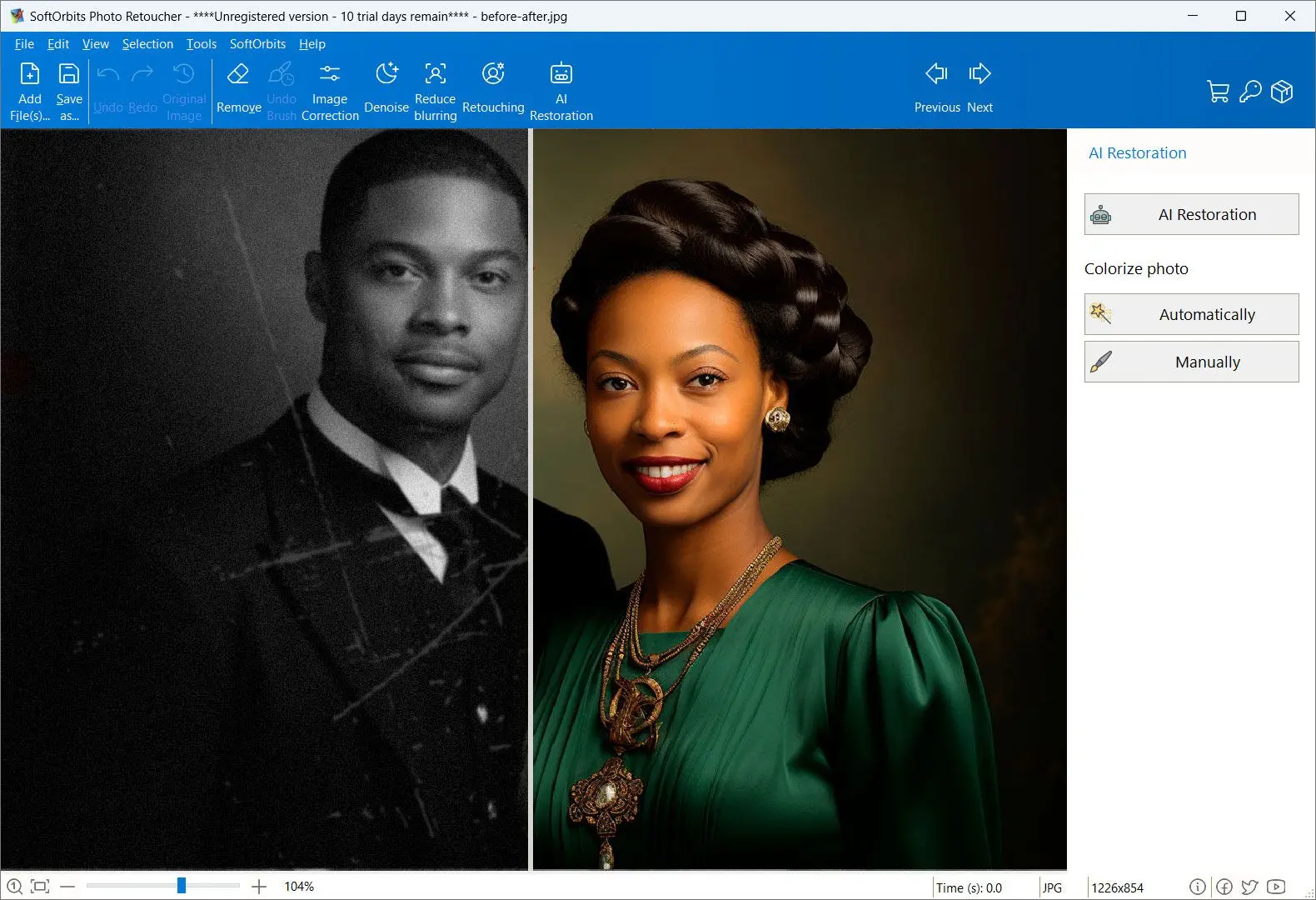
Restore and enhance old photos with SoftOrbits Photo Retoucher, AI-based photo restoration software. Remove scratches, reduce noise, and colorize black-and-white images automatically with AI.
Where does HitPaw FotorPea fall short?
Three gaps matter for old photos. AI face restoration goes soft or plastic under zoom, colorization drifts, the billing model depends on subscriptions plus credits. Part of the app also needs an internet connection.
Start with faces, because on a family photo the face is the whole point. The complaint that follows every AI enhancer in this class is the plastic look. As one tester who ran HitPaw alongside Topaz and Remini put it on Reddit, most AI upscalers "look impressive at first glance, until you zoom in and realize everything turned into plastic skin, fake textures, or oversharpened messes". FotorPea is not uniquely guilty here. It is squarely inside the pattern, and VideoProc's blurry-face finding is the same story from the other end. That is the surface of the problem. The deeper version, whether the model repaired the face or quietly replaced it, gets the section right after this one.
Colorization is the second gap. VideoProc's black-and-white test came back with visible inconsistencies across the frame, which matches what colorize models generally do when they have no reference: they guess, and the guess wanders between regions.
The third gap is commercial rather than technical, and it has the section above to itself: the credit balance under the plan price, the renewals, the cancellation trouble. It earns a place on this list anyway, because it is the thing that shapes how people shop in this category. The developer who announced a rival restoration app on r/windowsapps opened with exactly that: being tired of every AI photo app turning into a subscription trap, or asking you to upload family photos to a server you know nothing about.
That last part is the fourth gap. Tenorshare's review lists "limited offline functionality" as a con, and HitPaw's own credits page says the bundles "require an active subscription to unlock FotorPea's AI tools". So a folder of scanned family photos does not stay a private matter between you and the flatbed.
Restoring a face, or inventing one?
A generative model does not repair a face so much as redraw it. On a photo you have ten copies of, that is a curiosity. On the only surviving picture of your grandfather, a face that looks nearly right is a loss wearing the costume of a fix.
The sharpest statement of this came from a 3,800-upvote thread on r/ChatGPT about AI "restoration", and it fits in one line: the tool is not upscaling anything, it is making its own new image. People had fed in family photographs, got back clean portraits, and gradually worked out that they were looking at a stranger wearing a relative's haircut.
That is the mechanism working as designed, not a bug. Hand a model trained on millions of faces a patch of blur, and it fills the blur with the most plausible face-shaped thing it knows. It has no access to your grandfather. It has access to the average of everybody. Where the print still holds detail, the guess lands close enough to feel like memory. Where the print holds nothing, and a small 1962 snapshot holds very little around the eyes, the guess is free to be wrong, confidently, at high resolution.
Users of a rival upscaler stated the general law of it on r/LetsEnhanceOfficial. AI upscaling makes an image look worse when it guesses details that are not there. Warped text, invented fabric, skin that belongs to nobody. The strongest tool in the category carries the same habit. DPReview's test of Topaz Photo AI, cited further down this page, found it smoothing genuine detail off faces into plasticky skin. FotorPea is not the villain of this story. It is a member of a class, and the class has this property.
Check the result at 100 percent zoom, on the face, before you pay for anything. Identity lives in small landmarks. The shape of a nose. The set of the eyes. A mole, a scar, the exact line of a jaw. If the tool "improved" any of those, it did not restore your photo. Lower the strength and run it again.
Which is why a strength control matters more than a model count. Photo Retoucher rebuilds faces with CodeFormer and leaves the strength in your hands. Push it up and detail appears. Pull it down and the model stays nearer to what the negative actually recorded. We are not going to pretend that makes us magic. If the information is not in the grain, nobody puts it back without inventing it, not us, not FotorPea, not a model ten times the size. The real choice is between a tool that admits that and a tool that fills the hole for you and says nothing.
Best alternative: SoftOrbits Photo Retoucher
SoftOrbits Photo Retoucher takes the opposite bet. Instead of nine models for every photo job, it does one job: restoring old, damaged, faded photographs on Windows for a single payment.
The restoration pipeline is built around that job. A scratch detector finds the damage and LaMa inpainting fills it, so cracks, dust, tape marks disappear without you cloning them by hand. Faces run through CodeFormer, an open reconstruction model that rebuilds detail rather than smearing it. Black-and-white prints go through DDColor to colorize black and white photos automatically, and you can then correct the result by hand where the model guessed wrong. That second pass is the step most cloud tools never give you. There is also an enlarger for prints, an object remover for the stranger in the background, batch processing for a whole shoebox of scans.
Pick a model, spend credits, and watch the plan renew every month. Part of the workflow needs an account and a connection, so your family scans travel.
Install once, pay once, keep working when the router dies. The restoration models run offline, and there are no credits to top up.
The processing model matters more than the feature count here. Photo Retoucher pushes its AI through CUDA or DirectML, and falls back to the CPU on machines without a supported GPU. Pricing is a single license. Home costs $49.99, Pro costs $69.99. Against FotorPea's $90.39 yearly plan the Home license pays for itself inside the first year and then stops costing anything, which is the argument for old photo restoration software you own instead of rent.
Both sides, then. Pros first.
Built for one job: scratches, fading, noise, damaged faces on old prints
Runs locally on Windows; scans do not go to a cloud service
One payment ($49.99 Home) instead of a subscription with credits
Manual color correction after the AI pass, so you can fix a wrong guess
Batch mode for an entire folder of scans
Windows only, with no Mac build and no mobile app
Models download on first run, so you need the internet once
Narrow by design: no text-to-image generation, no face swap, no anime models
Batch AI passes on a CPU-only machine take real time
Verdict: Photo Retoucher is the pick for photos that are old, damaged and personal. That kind of job should finish, not renew every month. A generalist makes more sense if restoration is an occasional side quest.
HitPaw FotorPea vs SoftOrbits Photo Retoucher
Here is the side-by-side on the points people weigh before paying. FotorPea numbers come from HitPaw's own product and purchase pages, dated 12 July 2026; Photo Retoucher numbers come from our product data.| Feature | HitPaw FotorPea | SoftOrbits Photo Retoucher |
|---|---|---|
| Core job | All-round AI enhancer and upscaler | Old photo restoration |
| Pricing | $22.39/mo, $90.39/yr, $130.39 perpetual | One-time $49.99 Home / $69.99 Pro |
| Credits | Yes - 100 to 800 by plan, packs sold separately | None |
| Where it runs | Desktop plus account and online features | Locally on your PC, GPU or CPU |
| Free tier | Yes, but export is blocked | Free trial before you buy; 14-day money-back |
| Scratch and dust repair | Scratch Repair model | Scratch detector plus LaMa inpainting |
| Face restoration | Face model; blurry on old photos per independent test | CodeFormer reconstruction, dial-down strength |
| Colorize B/W | Colorize model; inconsistencies reported | DDColor plus manual color correction |
| Upscaling | Claimed up to 8K | AI enlarger up to 8x |
| Platforms | Windows, Mac, iOS, Android, Photoshop, web | Windows 10 and 11 |
| Extras | Background removal, face swap, AI generation | Object remover, concealer, clone stamp |
The split is clean. FotorPea wins on breadth and reach. It runs everywhere, it does more kinds of edits, and if your photo needs are varied it will cover more of them from one app. Photo Retoucher wins on the specific job this article is about. It repairs damage rather than re-imagining it, and it charges once. For a decent modern photo that just needs a touch-up, FotorPea is the more flexible pick. Rescuing a torn print from a shoebox calls for the specialist.
When is HitPaw FotorPea still the better pick?
FotorPea is the smarter buy when you are on a Mac or a phone, when you need one app for many kinds of edits, or when generative extras like background removal and face swap are part of your workflow. Photo Retoucher does none of that.
We are not going to pretend a specialist beats a generalist at being general. FotorPea genuinely wins in several cases.
If you are not on Windows, there is no debate at all. Photo Retoucher has no Mac build and no mobile app, so MacBook or iPhone rules it out entirely. FotorPea covers both, and it plugs into Photoshop or runs in a browser tab.
A varied photo workload changes the math: the breadth is worth paying for. Removing a background for a product listing. Swapping a face for a joke. Generating an image from a prompt, fixing a passport photo. All of it sits in one app. Photo Retoucher does none of those things and never will.
For heavy upscaling aimed at print, FotorPea headlines 8K output (its own page also says "resolution up to 4x"), while our enlarger works in multiples and stops at 8x. Neither number is a test result, so treat both as vendor specs. Our own answer to that job is a separate tool for people who batch upscale images rather than restore them. And if your photos are modern and mostly fine, only a bit soft or noisy, the generalist handles that class of fix well. That is the case where its own reviewers sound genuinely happy.
Is HitPaw FotorPea safe and legit?
FotorPea is a legitimate commercial product from HitPaw, a Chinese software company, and the app itself is not malware. The risk sits in the billing model and the cloud features, not in the download.
HitPaw is a real vendor with a real catalog, a Microsoft Store listing, and years of releases. The app is not a scam in the malware sense. The rating picture, though, deserves a look before you enter a card number. The public scores cover HitPaw the company, not FotorPea the product, and the two aggregators we checked land more than a full point apart.
That spread tells you something real. Complaints cluster on billing and cancellation, not on the software crashing or shipping something nasty. Treat it as a normal subscription risk. Note the renewal date, screenshot the 30-day refund terms, find the cancel button before you enter a card number.
Other HitPaw FotorPea alternatives we also considered
Topaz Photo AI, VideoProc Converter AI, and Remini all show up next to FotorPea in the same searches. None of them changed our recommendation for old-photo work, and each one loses on a different point.
the heavyweight of the category and a one-time purchase rather than a subscription, by HitPaw's own account on its comparison page. DPReview's review of Topaz Photo AI found it "has a tendency to yield an overly-smoothed look with unnatural, plasticky skin" on faces that already had detail - the same weakness.
the tool behind the most useful independent FotorPea test we found. It is a video-first suite with photo AI attached, so restoration is a side feature rather than the main event.
the phone-first face enhancer that appears in every upscaler comparison thread. It is fast and free to try, and it is also a frequent example of the plastic-face result people complain about.
dozens of them rank for the same keywords. They upload your family photos to a server, which is exactly the tradeoff the r/windowsapps thread above refused to make.
If you want the wider field with pros and cons for each, our roundup of photo restoration software compares eight tools side by side.
For torn, creased and dust-covered prints specifically, the dust and scratch removal software guide goes deeper on physical damage than any review of a single app can.
Which tool fits your photos?
Match the tool to the archive. Family scans with real damage want a specialist. Mixed creative work wants the generalist. A phone-only workflow rules out desktop tools entirely.
The family archivist has a box of prints, a flatbed scanner, one free weekend. The damage is physical. Creases, tape residue, silver mirroring, faded dyes. This person wants Photo Retoucher, because the tools map onto the damage one to one. A subscription is the wrong shape for a job that finishes.
The casual poster has a phone full of photos that are slightly soft, slightly noisy, about to go on Instagram. FotorPea handles that in seconds and looks good doing it, and mobile app means no desktop at all. Buy the monthly plan, run the batch, cancel.
The mixed-workflow creator sells on a marketplace, edits product shots, needs backgrounds gone, sometimes rescues an old photo for a relative. FotorPea's breadth wins here. The restoration will not be the best available, and for one photo a year that is a fair trade.
The one case with no good compromise is a heavily damaged photo that also matters. Reviewers found FotorPea blurry exactly there, and both aggregator complaints and the free-version export block make experimentation expensive. Run the specialist against the worst print in the box before you commit to either app.
Restore and enhance old photos with SoftOrbits Photo Retoucher, AI-based photo restoration software. Remove scratches, reduce noise, and colorize black-and-white images automatically with AI.
Sources